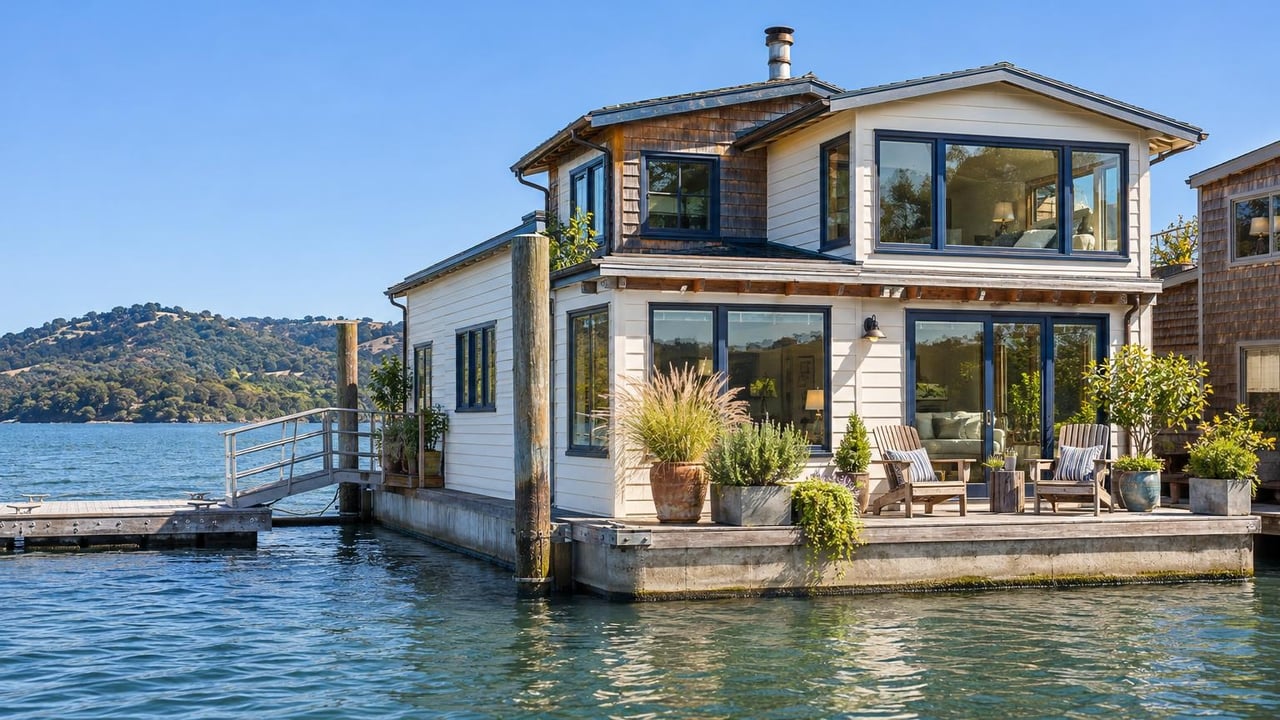
A Sausalito floating home is sold without the land under it. On Richardson Bay, the buyer pays the seller for the house and then pays the marina owner every month for the berth, so the asking price you see covers the structure and the land arrives as a bill. Anyone comparing a floating home with a condo in town or a cottage in Sausalito is comparing two different purchases. The useful comparison puts the price and the berth lease side by side.
The land shows up as a monthly bill
The Floating Homes Association, the Sausalito owners' group, compares the setup to a mobile home park. Residents own their homes and rent the berth from a landlord. That landlord owns the land under the marina, the docks, the utility lines and the parking, and handles their upkeep. According to the association's FAQ, berth fees depend on the size of the berth, the size of the home and how far it sits from shore. Most land around $1,000 a month and cover water, garbage, sewage, parking and common-area maintenance.
That figure is a general estimate, and individual marinas vary. In an October 2022 report by Latitude 38, the harbormaster at Yellow Ferry Harbor, a 22-home marina, put its average berth fee at about $1,500 a month at that time.
Simple arithmetic shows what this does to the comparison. A $1,000 berth fee is $12,000 a year. Over ten years that is $120,000, before any increases. A buyer on the water pays that to a landlord, month after month, for as long as they own the home, so the asking price and the berth fee have to be read together as one cost. The lease and rent history on the specific home are the documents that show what that monthly figure has been, and they are worth asking for early, before an offer is written. This post is general information and not legal, tax or financial advice, so confirm berth and loan figures for your own situation with the right professional.
Mirene and what a one-of-a-kind home is worth
The past year's best-known sale on the docks shows how hard these homes are to price. Mirene is a 64-foot tugboat built in 1912 and moored at South 40 Dock. It was the home of Whole Earth Catalog creator Stewart Brand and his wife, Ryan Phelan. The San Francisco Chronicle reported in October 2025 that it was listed at $1.8 million. In November 2025, The San Francisco Standard reported the same $1.8 million asking price, plus $700,000 for the couple's smaller houseboat on a neighboring dock.
Ten months later, The Standard reported on September 16, 2026, that after a year on the market and a major price cut, Mirene had a buyer. WordPress cofounder Matt Mullenweg confirmed he was buying both homes. By then Mirene was listed at $1 million and the smaller home at $500,000. The deal was in contract, and both sides declined to reveal the price.
The Standard called Mirene the only Sausalito houseboat that is allowed to leave the dock. That made it rare even among floating homes, and rarity is hard to price. With no land under it, the value rests on the structure, its history and the berth it holds. Over that year, the asking price moved 44% from its starting point before a buyer signed.
Asking prices along the docks
Ordinary floating homes cover a wide range. In May 2024, The San Francisco Standard reported asking prices from $425,000 for a 300-square-foot home on Main Dock to $1.795 million for a 1,728-square-foot home at the end of Gate 6½ Road. Those were asking prices, more than two years old by now, and they show spread rather than current value. They do show that size and location along the docks move price the way they do on land. The same factors, home size and distance from shore, also set the berth fee. A larger home farther out tends to cost more twice, once in the price and again every month in the berth fee.
Finding these homes works much like it does on land, with one local habit added. The association notes that floating homes are listed on the Multiple Listing Service, and that sale and rental notices are often posted on the bulletin boards at the front of each dock.
Who you buy from, and who you rent from
At Waldo Point Harbor, the two-part purchase is explicit. The harbor's website describes a privately owned marina with 282 berths. It does not sell homes itself. Buyers purchase the floating home from its owner and take over the lease for the berth. So every purchase involves two counterparties: the seller, who sets the price, and the marina, which sets the lease terms the buyer will live under.
The marinas themselves have institutional business underway. The association's January 2026 newsletter said Waldo Point Harbor, Kappas Marina and Yellow Ferry Harbor were all due to renew their permits. Separately, the Marin Independent Journal reported in May 2026 that the Sausalito City Council had chosen a pilot proposal for a reconfigurable modular floating dock at the end of Turney Street. A buyer comparing homes at different marinas can reasonably ask the seller or harbor office about the current status of the permits and leases.
How the purchase gets paid for
Financing follows the same split, with lending built around the home itself. Bank of Marin's floating home loan page lists loan amounts up to $1 million for eligible one-unit homes with a concrete hull. The concrete hull requirement matches how most of these homes are built. The association describes what looks like a concrete foundation as a concrete barge that floats at high tide and settles onto the mud at low tide.
The association's January 2026 newsletter said it had identified three lenders willing to serve qualified floating-home owners. It had worked with them on eligibility and rates for first mortgages and home-equity loans. A buyer should line up financing before choosing a home, because the hull type and the loan limit can rule out a home before price does.
Frequently asked questions
What does a floating home's asking price cover? The structure. The buyer purchases the home and rents the berth under it. The Floating Homes Association puts most berth fees around $1,000 a month, which covers water, garbage, sewage, parking and common-area upkeep. The cost of the land is paid monthly instead of in the price.
Does Waldo Point Harbor sell homes directly? No. The harbor states that it does not sell homes. Buyers purchase from owners and take over the berth lease.
Can a floating home be financed? Yes. Bank of Marin lists floating home loans up to $1 million for eligible one-unit homes with concrete hulls.
If you're weighing a floating home against a house on land, we can go through both together, with the berth lease, the rent history and the financing next to the asking price. Visit our buyer resources, or schedule a conversation with the Faber Real Estate Team and bring the dock listings you've been watching. Let's Talk Real Estate.